
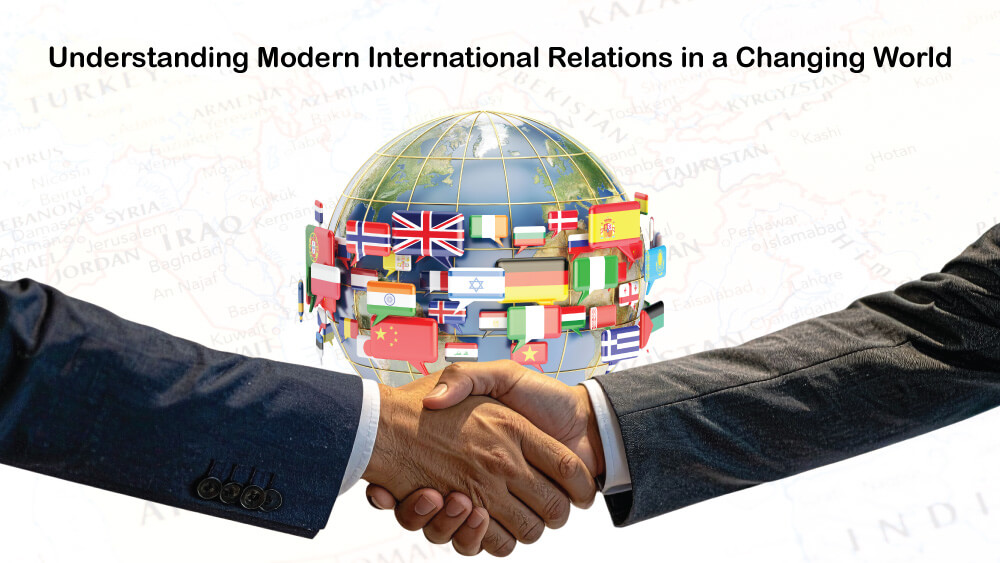
In today’s interconnected and rapidly evolving global landscape, international relations are more dynamic than ever before. From shifting alliances to emerging powers, global diplomacy is constantly adapting to new challenges and opportunities. Understanding modern international relations is essential for anyone seeking to grasp how nations interact, cooperate, and compete in a changing world.
This comprehensive guide explores the core elements shaping global politics today, offering insights into the forces driving international affairs and what they mean for the future.
Modern International Relations
Modern international relations refer to the complex interactions between countries, organizations, and global actors in political, economic, and social spheres. Unlike the rigid power structures of the past, today’s world is characterized by fluid alliances, multi-polar power distribution, and increased global interdependence.
As highlighted by Global News Grid, understanding these interactions is crucial for analyzing global events, policy decisions, and their impact on everyday life.
The Evolution of Global Diplomacy
International relations have undergone significant transformations over the past century. From colonial empires to sovereign nation-states, and from Cold War rivalries to cooperative globalization, diplomacy has evolved alongside global realities.
The aftermath of the World War II marked a turning point, leading to the creation of global institutions and a renewed emphasis on peacekeeping. Later, the Cold War shaped international relations through ideological competition.
Today, diplomacy is more nuanced, involving not only governments but also non-state actors, multinational corporations, and global institutions.
Key Players in Today’s Global System
Nation-States
Countries remain the primary actors in international relations. Major powers such as the United States, China, and India significantly influence global policies, trade, and security.
Emerging Powers
Countries like Brazil and South Africa are gaining prominence, contributing to a more balanced global power structure.
Non-State Actors
Organizations, corporations, and even individuals play a crucial role. Multinational companies, NGOs, and activist groups influence policy decisions and global agendas.
The Role of International Organizations
Global organizations are vital in maintaining order, promoting cooperation, and addressing international challenges.
- United Nations (UN): Focuses on peacekeeping, humanitarian aid, and international law.
- World Trade Organization (WTO): Regulates international trade.
- International Monetary Fund (IMF): Supports global financial stability.
- North Atlantic Treaty Organization (NATO): Ensures collective security among member states.
These institutions help mitigate conflicts, foster economic growth, and promote international cooperation.
Emerging Trends in Global Politics
Multipolar World Order
The dominance of a single superpower is fading. Instead, multiple countries now share influence, creating a more complex and competitive environment.
Rise of Regional Alliances
Regional groups such as the European Union (EU) and ASEAN are becoming increasingly influential.
Shift in Power Dynamics
Economic growth in Asia and Africa is reshaping global power balances, challenging traditional Western dominance.
Impact of Technology on International Relations
Technology has revolutionized the way countries interact and compete.
- Cybersecurity threats have become a major concern.
- Digital diplomacy allows nations to communicate directly with global audiences.
- Artificial intelligence is influencing defense strategies and economic competition.
Social media platforms also play a role in shaping public opinion and international narratives.
Economic Interdependence and Trade Dynamics
Globalization has interconnected economies, making countries more dependent on one another.
Trade Agreements
Bilateral and multilateral agreements influence economic relations and market access.
Supply Chains
Modern economies rely on complex supply chains spanning multiple countries, making disruptions impactful worldwide.
Economic Rivalries
Trade tensions between major economies can affect global markets and political relationships.
Security Challenges in a Changing World
Security remains a central concern in international relations.
Traditional Threats
Military conflicts, territorial disputes, and nuclear proliferation continue to pose risks.
Non-Traditional Threats
- Terrorism
- Cyber warfare
- Pandemics
- Organized crime
These challenges require coordinated global responses.
Climate Change and Global Cooperation
Climate change has emerged as one of the most pressing global issues.
International agreements like the Paris Agreement aim to reduce greenhouse gas emissions and promote sustainability.
Countries must collaborate to address environmental challenges, as their impacts transcend borders.
The Future of International Relations
The future of international relations will likely be shaped by:
- Continued rise of emerging economies
- Increasing importance of technology
- Greater emphasis on sustainability
- Evolving global governance structures
As the world becomes more interconnected, cooperation and competition will coexist, defining the global order.
Global News Grid continues to analyze these transformations, offering valuable insights into the ever-evolving world of international affairs.
Conclusion
Understanding modern international relations is essential in navigating today’s complex global environment. With shifting power dynamics, emerging challenges, and increasing interdependence, the world is undergoing significant transformation.
From global institutions to technological advancements, every aspect of international affairs is evolving. Staying informed through trusted platforms like Global News Grid ensures a deeper understanding of these changes and their global implications.
As nations continue to adapt to new realities, the importance of diplomacy, cooperation, and strategic decision-making will only grow in shaping the future of our world.
FAQs
What are international relations in simple terms?
International relations refer to how countries interact with each other through diplomacy, trade, conflict, and cooperation.
Why are international organizations important?
They help maintain global stability, resolve conflicts, and promote economic and social development.
What is a multipolar world?
A multipolar world is one where multiple countries hold significant power rather than a single dominant nation.
How does technology affect international relations?
Technology influences communication, security, economic competition, and public diplomacy.
What role does climate change play in global politics?
Climate change drives international cooperation and policy-making, as it impacts all countries globally.


